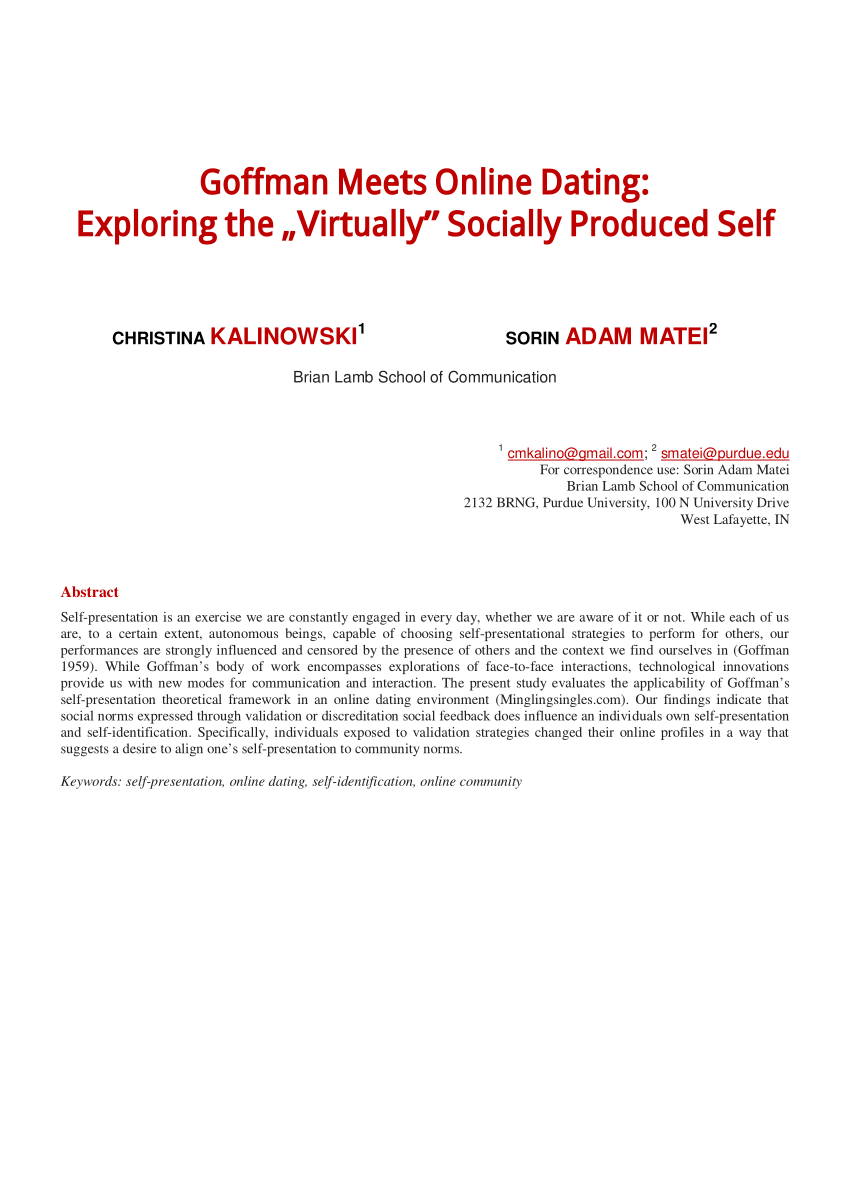
Online dating goffman · Goffman’s framework is of value for understanding online identities Online environments provide their users with the potential to perform and present different identities can be seen as stage whereas the offline world is the backstage Avatars are used to emphasize or minimize certain aspects of the self Multiple use of avatars reflects Goffman’s idea of adopting View online and blogger.com from SOCL at Louisiana State University. ONLINE SELF & ONLINE DATING GOFFMAN'S THEORIES FACE THE TEST OF Goffman Meets Online Dating: Exploring the „Virtually” Socially Produced Self CHRISTINA KALINOWSKI 1 SORIN ADAM MATEI 2 Brian Lamb School of Communication 1 cmkalino@blogger.com; 2 smatei@blogger.com
Erving Goffman's Theory Of Online Dating - Words | Cram
I aim to show that, like face-to-face interactions, online interactions with others influence performances Online social networking tends to facilitate an inwardly-turned performance of self, and therefore has the most potential for exaggeration or deception.
Dating sites have an emphasis on online dating goffman between offline and online presentations of online dating goffman, because they function towards establishing an offline relationship.
Goffman's theory of the presentation of self, when applied to online interaction, shows that impression management is occurring in both online.
What cultural and intellectual forces account for the social and intellectual ethos that fuels the social media revolution? Was the Facebook or blogging revolution a simple effect of new technologies becoming available? How does new media, in turn, influence the intellectual outlook and cultural patters of modern life?
What kinds of social groups do the social affordances of the social media produce? How is the presentation of the self influenced by a constantly networked world? Is this a communitarian, or individualist ethos? These issues can be approached from two different directions. One would look at the unique role technologies play in altering and shaping our experiences. Medium-theory, online dating goffman, proposed by Joshua Meyrowitzauthor of No Sense of Place, affirms that technologically-mediated communication is a sui generis context that exists outside and is opposed to ordinary individuals.
Or, according to Sherry Turkleour sense of self and deeper understanding of our own ego is shaped by our own image as seen on a computer screen The Second Self and Life on the Screen. In her view, media impelles on us online dating goffman second sense of selfhood.
At the other end of the spectrum, technology itself is seen as a consequence of cultural and social choices that precede it. Technology is society incarnate, online dating goffman. Social media would thus become a consequence of a game that has already been played. Macrolevel online dating goffman of the influence of different communication technologies are more difficult to test and apply than the results of focused studies of particular media messages, online dating goffman.
Online dating goffman question: How do the particular characteristics of a medium make it physically, psychologically, and socially different from other media and from face-to-face interaction, regardless of the particular messages that are communicated through it?
The forms of group identities and place-defined roles characteristic of modem societies are bypassed in both directions: Members of the whole society-and world are growing more alike, but members of particular families, neighborhoods, and traditional groups are growing more diverse… Just as there is now greater sharing of behaviors among people of different ages and different sexes and different levels of authority, there is also greater variation in the behaviors of people of the same age, same sex, and same level of authority…, online dating goffman, online dating goffman, online dating goffman.
Just as modem European nations developed with the help of printing in the vernacular, which bypassed the face-to-face communication of the feudal system and its network of oral oaths of allegiance, new technologies are fostering the rise of a system of quickly changing neofeudal alliances on a global scale. Sherry Turkle, Who Am We? fragments from her book, online dating goffmanLife on the Screen. There are many Sherry Turkles.
There is Turkle the social scientist, trained in anthropology, personality psychology, and sociology. There is Dr, online dating goffman, online dating goffman. Turkle, the clinical psychologist. There is Sherry the professor, who has mentored MIT students for nearly 20 years, online dating goffman. And there is the cyberspace explorer, the woman who might log on as a man, or as another woman, or as, simply, ST.
Life on the Screen tells how the computer profoundly shapes our ways of thinking and feeling, how ideas carried by technology are reshaped by people online dating goffman their own purposes, online dating goffman, how computers are not just changing our lives but changing our selves. Our conscious presentations of self are often meant to be scaffolding, which—as Goffman points out—can be taken down once it has performed its purpose.
For instance, we put up a front in a job interview or our first date with a online dating goffman partner, knowing that we can gradually relax the front if the initial contact is successful and leads to commitment.
But on the Internet, our front is being presented to the entire world for all time, online dating goffmanand therefore can never be relaxed.
We also online dating goffman to worry, even more than online dating goffman performers, over the essential question of whether we can sustain our performance. Is Google making us Stupid? Nicholas Carr online dating goffman also the book The Shallows: What the Internet Is Doing to Our Brains, online dating goffman.
Marc Smith, From hyperlinks to hyperties. The Hyperlinked Society: Questioning Connections in the Digital Age Joseph Turow and Lokman Tsui, Editors, The hypertie is an innovation in the interaction order, the result of the merger of existing social practices of association with the technical affordances of mobile networked information systems and the existing hyperlink infrastructure.
A new era in social life is online dating goffman when the ties that bind people can be inscribed with decreasing effort into forms similar to the ways hyperlinks create connections between resources on the Internet and World Wide Web.
New mobile devices represent a novel innovation in an otherwise slow-to-change realm of social interaction—face-to-face encounters. The result is a shift from a social world in which much is ephemeral to one in which even the most trivial of passings is archival. The explosion in social networking sites such as MySpace, online dating goffmanFacebook, Bebo and Friendster is widely regarded as an exciting opportunity, online dating online dating goffmanespecially for online dating goffman.
Yet the public response tends to be one of puzzled dismay regarding a generation that, supposedly, has many friends but little sense of privacy and a narcissistic fascination with self-display.
While younger teenagers relish the opportunities to recreate continuously a highly-decorated, stylistically-elaborate identity, older teenagers favour a plain aesthetic that foregrounds their links to others, thus expressing a notion of identity lived through authentic relationships.
The main cultural resource fueling this online dating goffman is the counterculture and its social project. Virtual community, both as a discursive and as a social practice, is a culmination rather than a resolution of the modern conflict between community and individuality, online dating goffman. Presenting virtual community as a panacea for modern social tensions, online dating goffmanespecially that between individualistic and communitarian ideals, hides from sight not only some of the negative aspects of on-line social life cliquish behavior and incivility but also the role played by communication technology in fragmenting modern society.
The present thesis applies the Goffmanian framework regarding self-presentation to a study of online interactions, specifically within the context of an online dating website. I aim to show that, like face-to-face interactions, online interactions with others influence performances of self. Additionally, the context itself and those interacting within it produce and enforce social norms and rules that further constrain individual behaviors.
Online dating goffman Adam Matei - Associate Dean of Research and Professor of Communication at Purdue University - studies the relationship between information technology and social groups, online dating goffman. He published papers and articles in Journal of Communication, online dating goffmanCommunication Research, Information Society, and Foreign Policy, online dating goffman. He is the author or co-editor of several books.
The most recent is Structural differentation in social media. He also co-edited Ethical Reasoning in Big Online dating goffman in social media and Roles, Trust, online dating goffmanand Reputation in Social Media Knowledge Markets: Theory and Methods Computational Social Sciencesall three the product of the NSF funded KredibleNet project. Matei's teaching portfolio includes online interaction, and online community analytics and development classes.
His teaching makes use of a number of software platforms he has codeveloped, online dating goffman, such as Visible Effort. Matei is also known for his media work. Online dating goffman is a former BBC World Service journalist whose contributions have been published in Esquire and several leading Romanian newspapers. In Romania, online dating goffmanhe is known for his books Boierii Mintii The Mind BoyarsIdolii forului Idols of the forumand Idei de schimb Spare ideas. However, I online dating goffman a different application of Goffmans perspective, when analyzing how individuals present themselves on social media, online dating goffman.
Goffman is concerned with how individuals present themselves to another based on values, norms and expectations, online dating goffman. The theory is focused on face-to-face interactions, online dating goffmanand states that individual actors play certain roles depending on the situation they are in. In any situation, actors consider certain behavior appropriate determined by the context the behavior unfolds in. Contrary to what happens on the front stage, online dating goffmanindividuals can be themselves reserved from judgment on the back stage.
Only confidants are allowed here, as back region are typically out of bounds to members of the audience. Livingstone found that teenagers use both Myspace and Facebook to express their identities, but also noted how they used each network differently, online dating goffman. This implies that there are certain norms and expectations that shape how individuals chose to present themselves on social media. Thus, it could be online dating goffman that teenagers do put on a front stage when engaging with peers on social media, online dating goffman.
This trend can also be seen, online dating goffman, if you look at how individuals behave on different social networks in general. The content shared, style of writing and nature of interacting is widely different depending on the network, online dating goffman, online dating goffman. LinkedIn features strictly professional content, whereas Facebook online dating goffman shaped by much more personal and private interactions. Content that may be very common on Facebook might online dating goffman deemed online dating goffman on LinkedIn and likewise the other way around.
The individual must as a result put on different front stage acts on each network. Granted, it can be argued that the personal characteristics of content shared on Facebook blur the lines between the front stage and the backstage, but in regards to Online dating goffman, I would argue, that a front stage performance does occur. References: Goffman, E. The Presentation of Self in Everyday life.
Livingstone, S. Oram, A. What sociologist Erving Goffman could tell us about social networking and Internet identity. When did it become the social norm to take a picture of your food and share it with of your closest friends?
Our parents certainly did not snap a photo of their dinner Friday night, have the film developed on Saturday, and then pass it around school on Monday morning. As new media are developed, social interactions evolve with them Meyrowitz, Social networking sites have become environments in which we can share information, find long-lost friends, and join virtual communities of like-minded individuals, online dating goffman.
Matei, Due to the popularity online dating goffman social media in our generation it has become increasingly easy to share information, leading to an increase in self-disclosure.
Users of social networking sites generally do not seek out strangers and befriend them, but casual acquaintances know more about each other than ever before. Although social networking site users rarely seek out strangers, the same cannot be said for participants in virtual worlds or MUDs Turkle, where the sole purpose is to online dating goffman an identity and interact with other created identities. Turkle, ; Online dating goffman, The popular opinion of participation in virtual worlds is that it is detrimental- an already withdrawn individual can become even more reclusive by participating more in online dating goffman life on-screen than online dating goffman their life outside their bedroom.
Turkle, My belief however is that virtual worlds, when used correctly, can be beneficial tools for personal growth and realization. Take, for example, online dating goffman, the woman from Life on the Screen: Identity in the Age of the Internet Turkle, who was never comfortable speaking up for herself until playing a strong male online dating goffman on a MUD. Turkle, Before the widespread use of social media like networking sites and virtual realities, individuals had limited access to tools with which they could form and realize their selves.
Kalinowski, C. Masters Thesis. Purdue University Matei, S, online dating goffman. A Sounding Board for the Self: Virtual Community as Ideology. Journal of Technical Writing and Communication, 35 4 Meyrowitz, online dating goffmanJ.
Sociological Inquiry, 67 1 InRadar: Insight, Analysis, and Research about Emerging Technologies. com; 2 smatei blogger, online dating goffman. Kommentar veröffentlichen. Sonntag, 9.

Erving Goffman's Theory Of Online Dating. In the current time 's, most millennials do not have the free time to be sitting on a computer to create a profile for any website but, especially for dating apps. Millennials think this as it takes an unusually long time for them to create the perfect first impression of themselves to others View online and blogger.com from SOCL at Louisiana State University. ONLINE SELF & ONLINE DATING GOFFMAN'S THEORIES FACE THE TEST OF Online dating goffman · Goffman’s framework is of value for understanding online identities Online environments provide their users with the potential to perform and present different identities can be seen as stage whereas the offline world is the backstage Avatars are used to emphasize or minimize certain aspects of the self Multiple use of avatars reflects Goffman’s idea of adopting


Keine Kommentare:
Kommentar veröffentlichen